

Dear reader,
There is a particular kind of sunrise breeze that signals to your nervous system that you are now in the jungle. And the jungle, in every sense of the word, is Kerala, India.
Just an hour and a half flight from The Maldives, and we had arrived at my mother’s motherland — Kerala, the southwestern tip of India, otherwise known as God’s Own Country.
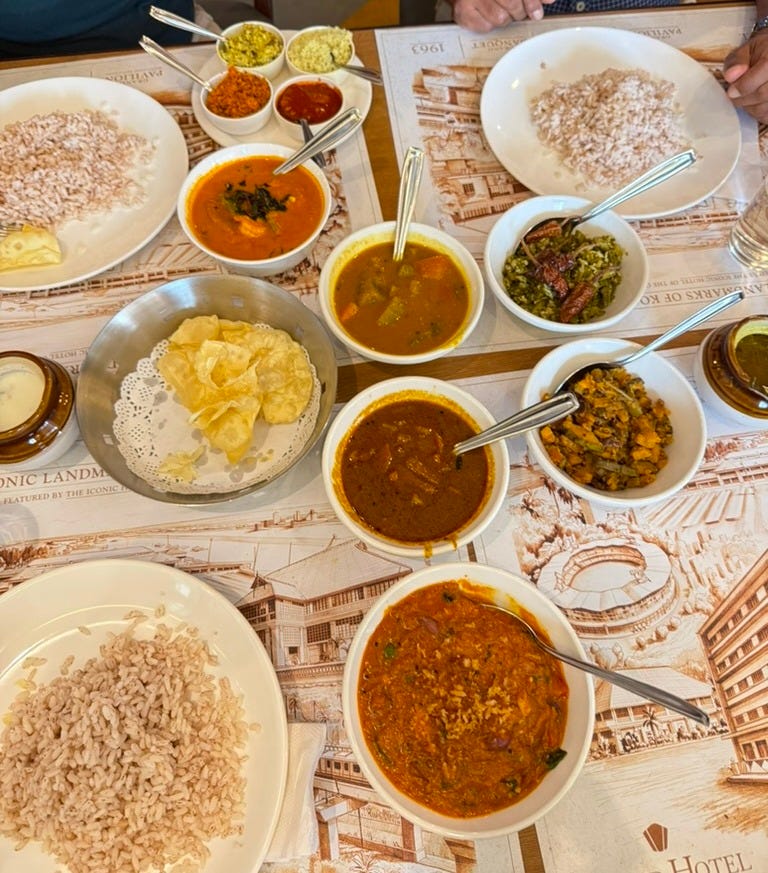
It would be remiss of me to skip where we stopped to eat on the way from the airport: The Grand Hotel in Ernakulam. There is 1963 old-world charm aplenty everywhere you turn there, and its classic wooden cool is nestled between new high-rise biophilic hotels in the city. The restaurant was packed, most likely for its Suriani-inspired menu that is especially beloved by NRIs (Non-Resident Indians) visiting from abroad. A Suriani-inspired menu (Syrian Christian cuisine from Kerala) focuses on rich, coconut-based dishes, fish, and is often curated to reflect traditional festive feasts and delicacies. A wonderful friend of the family who possesses such a gift for attention to detail had arranged a welcome meal for us there. It was a joy to finally thank him in person for the many thoughtful arrangements he has made for us over the years. Hospitality, I am honoring again and again, is a shared energy that makes living so much more meaningfully connected.
This was my second adulthood visit to my grandmother’s old home in the central city of Changanassery. Coming back to a place for a second time holds so much promise and so much angst at the same time. There is a pressure to do right by the opportunity, and a softness to simply want to be in the familiarity of it all.
Back in Changanassery, that sunrise breeze arrives unhurried, and it is worth rising early for every single time. Before the city wakes up, it is magical to stand on the roof and watch the pastel glow of the sun spread inch by inch.
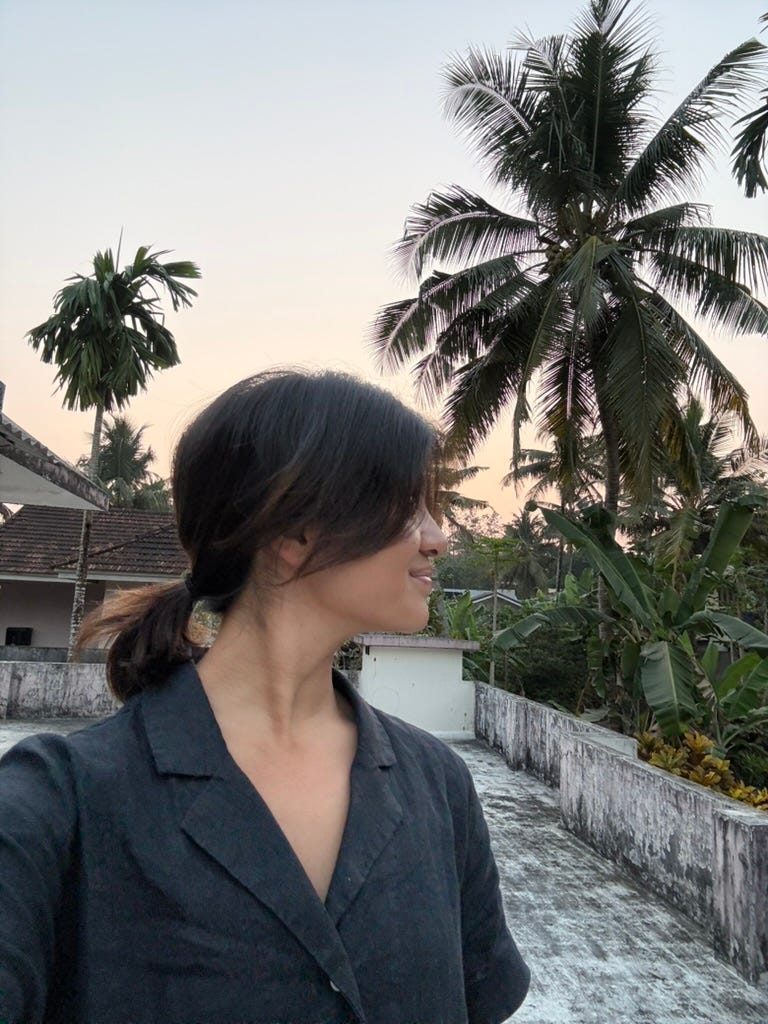
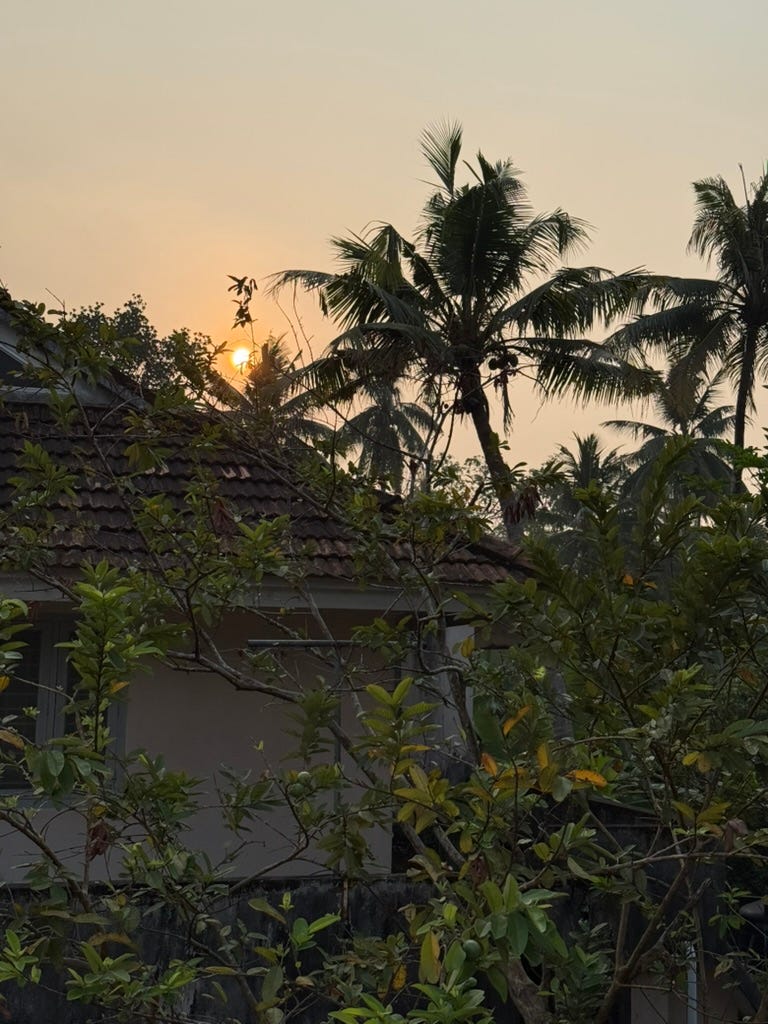
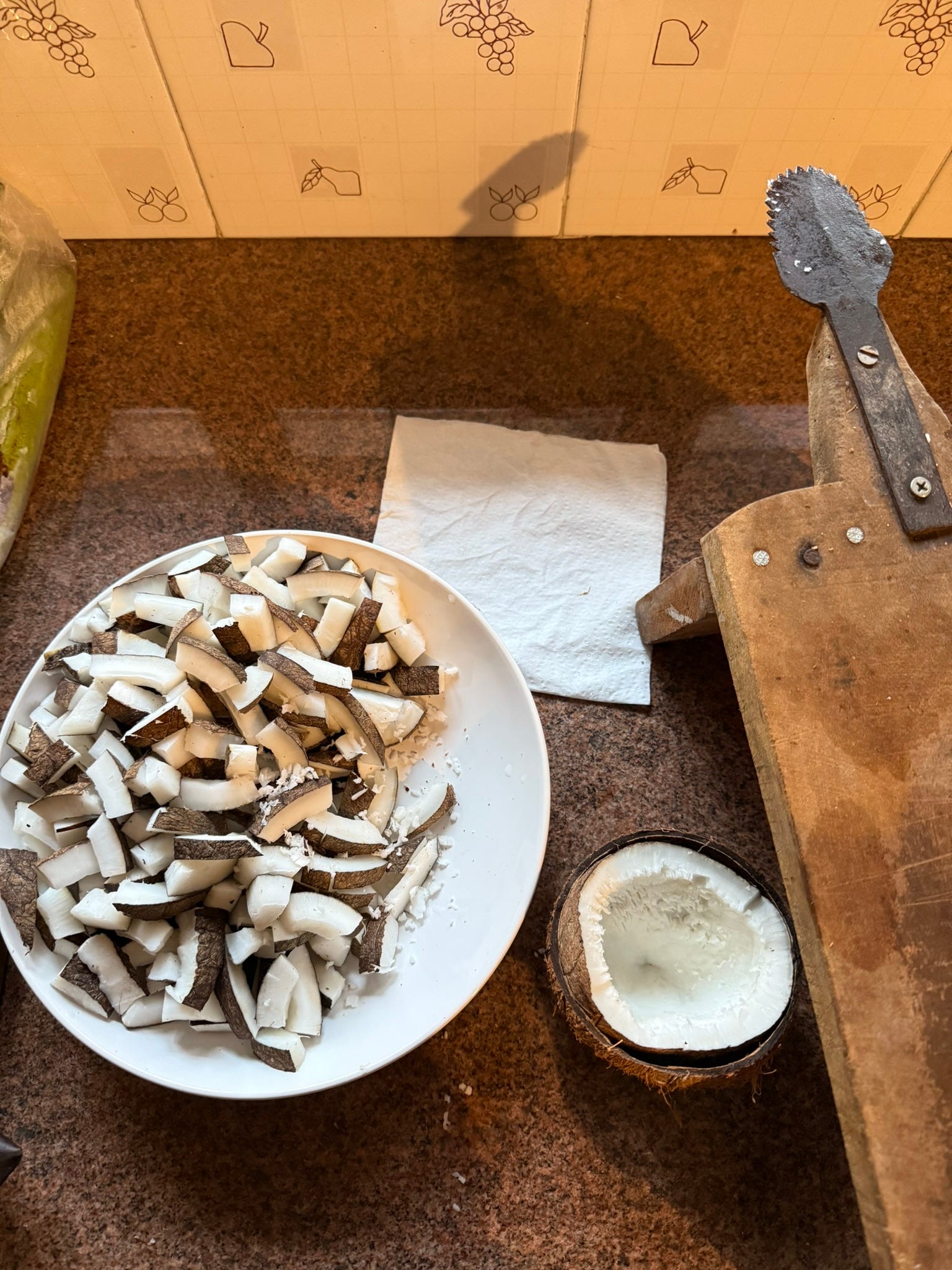
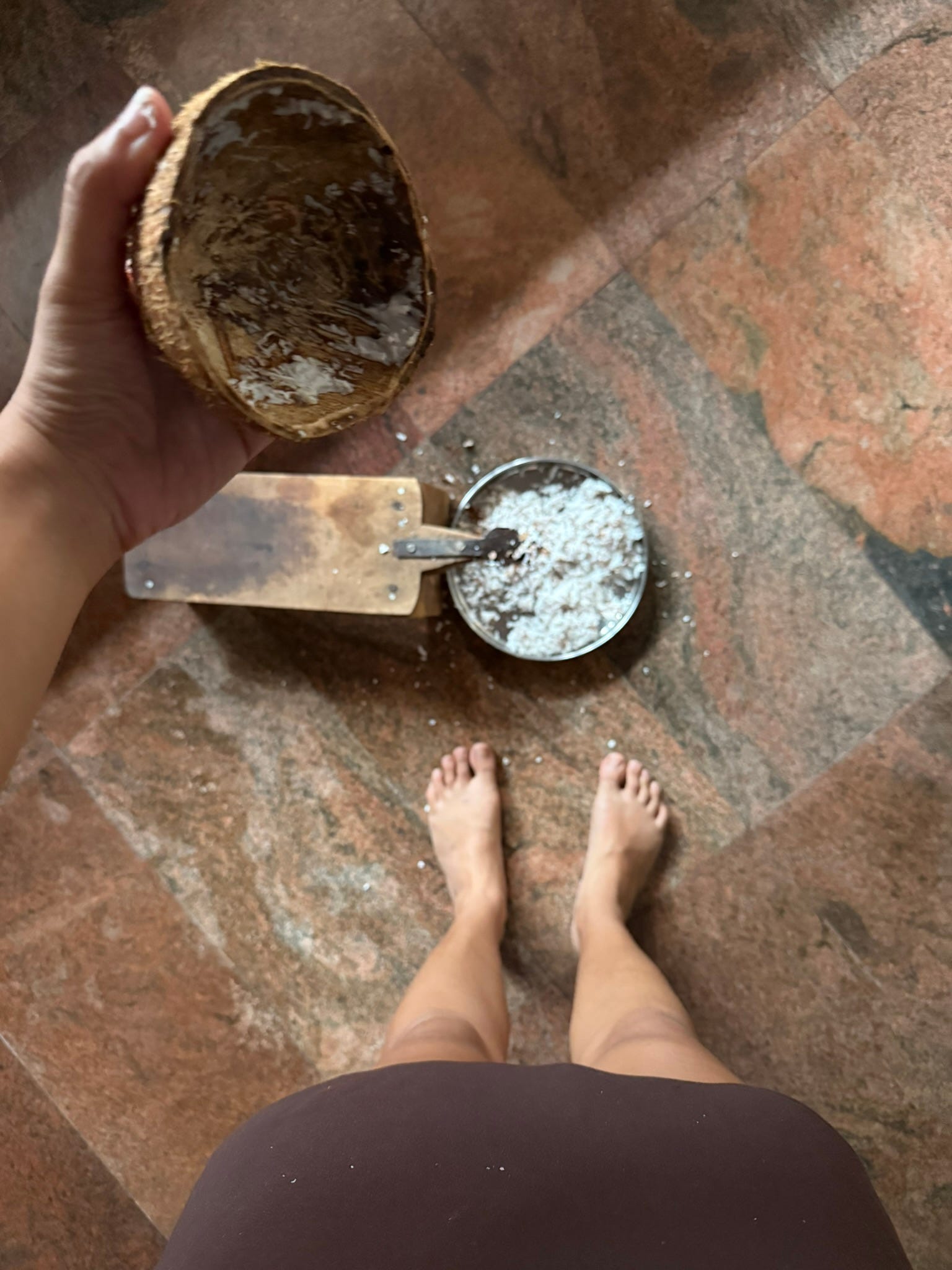
Even though it was February, it was the beginning of the summer season in Kerala. The rhythm of the days established itself fast. The equatorial sun clocked in around ten and didn’t clock out until four — merciless, humbling. At 4pm, the golden light hit the gently dancing leaves just right and the whole place exhaled. And everywhere, always, the coconut. Falling from trees with a thud that would make anyone jump. Cracked open for water. Shredded into chutneys. Pressed into oil. Folded into every curry you’ve ever loved. In Kerala, the coconut is not an ingredient. It is the plot. You can make anything from it. You can live off of it. There is everything in a coconut shell. And learning to craft dishes and tools with it is very empowering. Today, I feel 100% capable of cracking open, opening, and shredding coconuts with the help of the tools passed on by my ancestors. What a freedom it is to feel efficacious, in even the perceivably small ways, in a society that can constantly make us feel helpless.
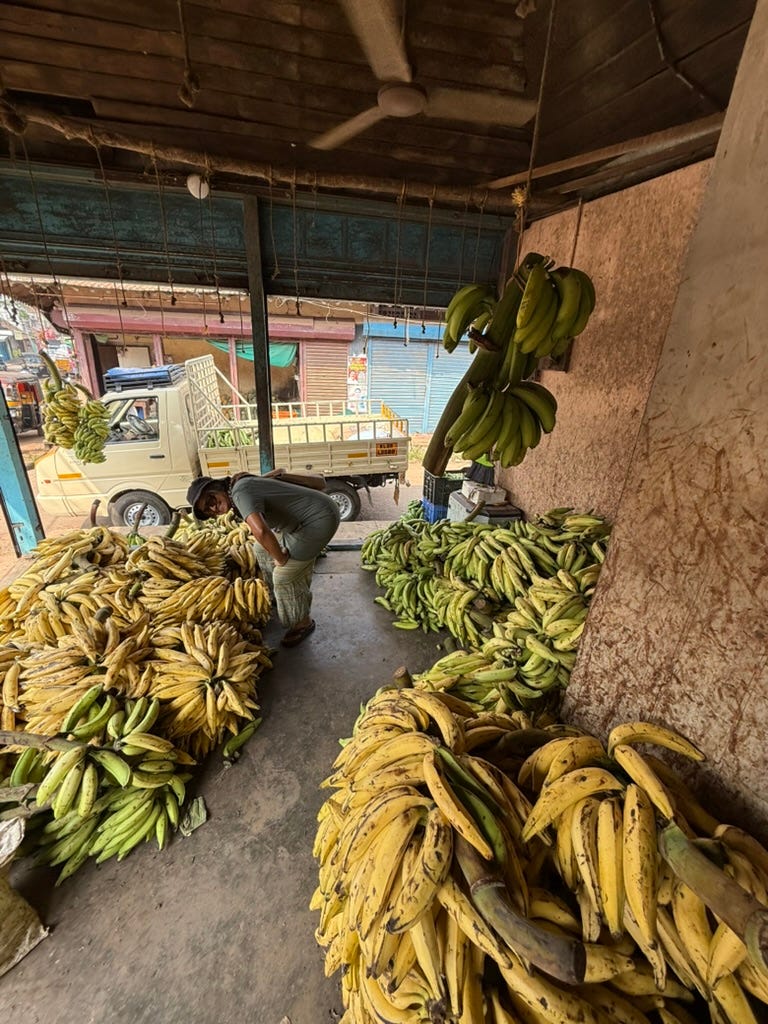
I will be honest with you: for as lovely a place as it is, this place is not without its fractures. Corruption is present in the everyday. In institutions, in transactions, in the gap between what is said and what is done. I felt the helplessness of it more than once. And I kept returning to a note I had made to myself early in the trip: corruption is all around — go on living and making goodness anyway.
And then, miraculously, Kerala kept showing me exactly how.
A man who earned 1,000 rupees (roughly $10) a day did the manual labor of three people and showed up with more integrity than rooms full of far wealthier men. I served him tea and biscuits the way my grandmother used to, and I felt her in my hands as I did it. An 85-year-old woman, no taller than 4’7”, whipped a bag of coconuts over her shoulder and walked herself home without accepting my help. And a neighborhood dog — a street survivor with no resentment I could detect — sat gracefully behind a net while people threw bricks to shoo her away, and then, once they passed, continued following us home with a bright smile.
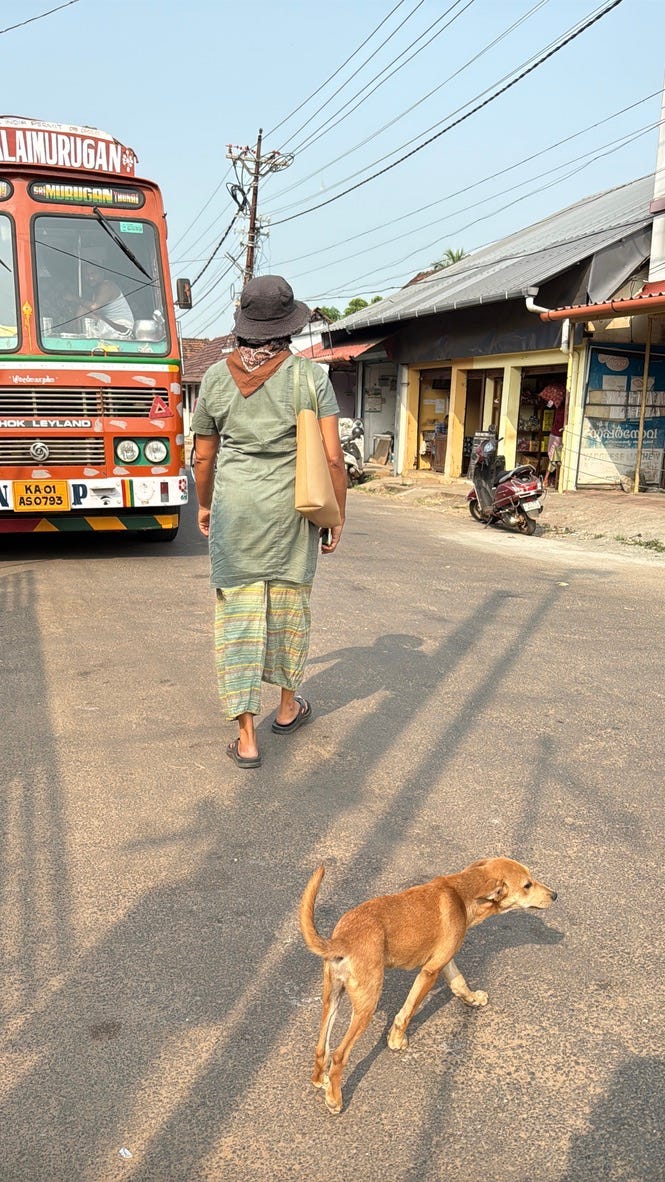
The corruption did not kill the goodness. The goodness did not extinguish the corruption. Both are real. And somewhere in the middle of all of it, you still have to be exactly who you are and decide who you are going to be in order to thrive here.
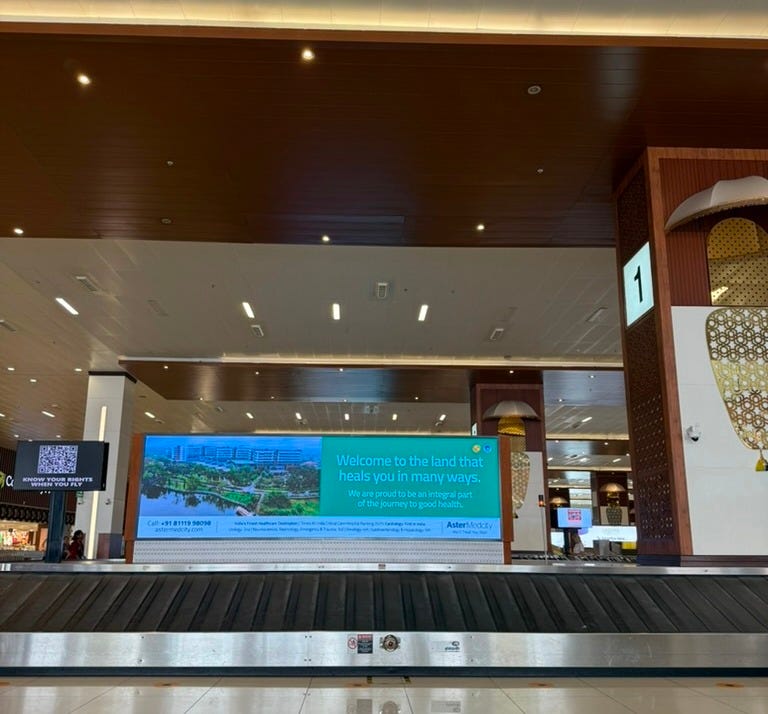
On the other hand, Kerala is “the land that heals.” It is the land of the ancient nature medicine field Ayurveda, which loosely means “science of life.” At the Ayurveda place just across the street from my grandmother's home, we got abhyanga massages. Four hands working in synchronized rhythms on a wooden table, followed by a guillotine-style steam sauna wooden box (claustrophobes beware!). Natural circulation boost and inflammation reduction. The body keeps its own score and needs constant tending. If you go, immerse in authentic healing Ayurveda. It is worth every minute.
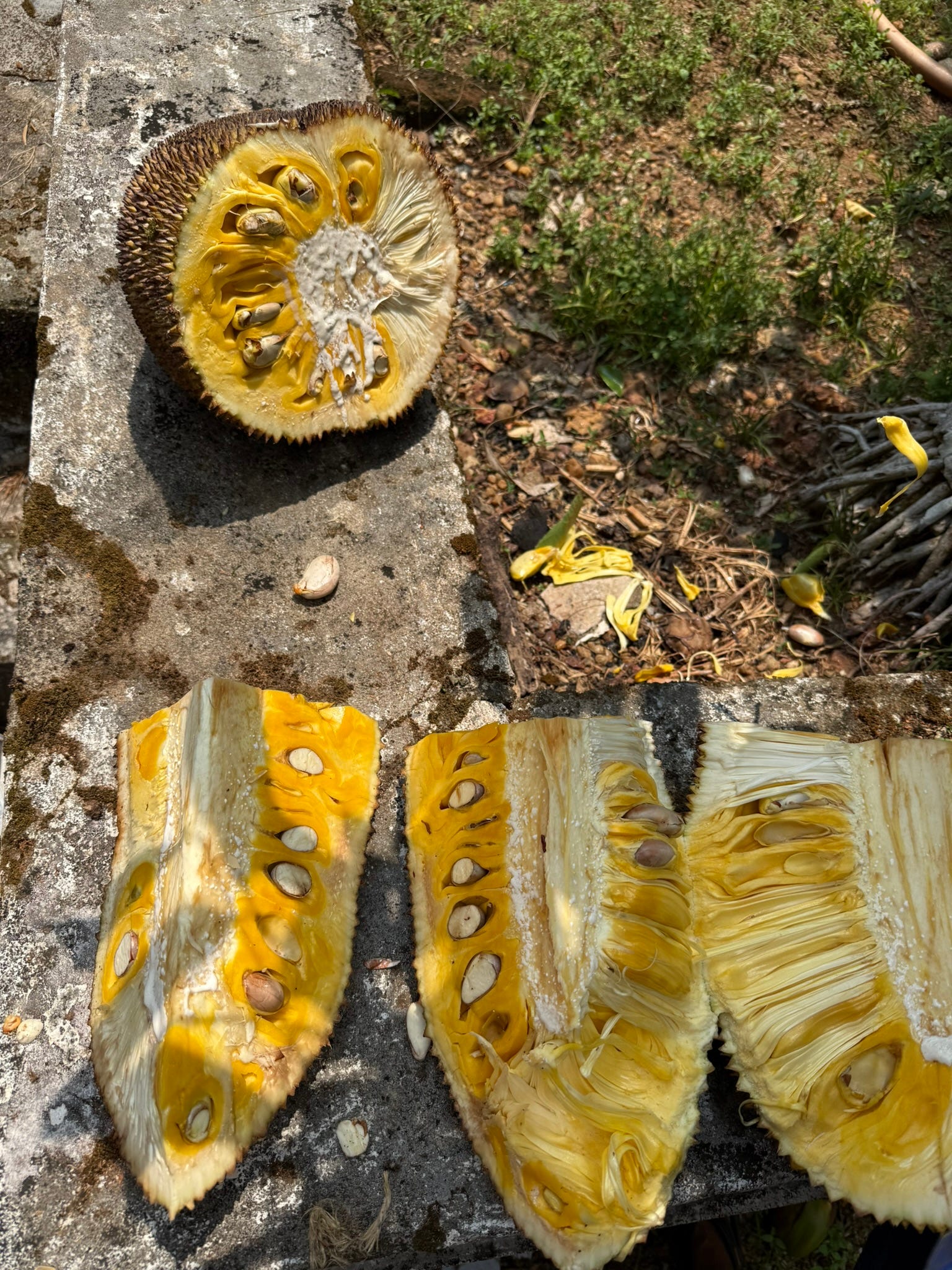
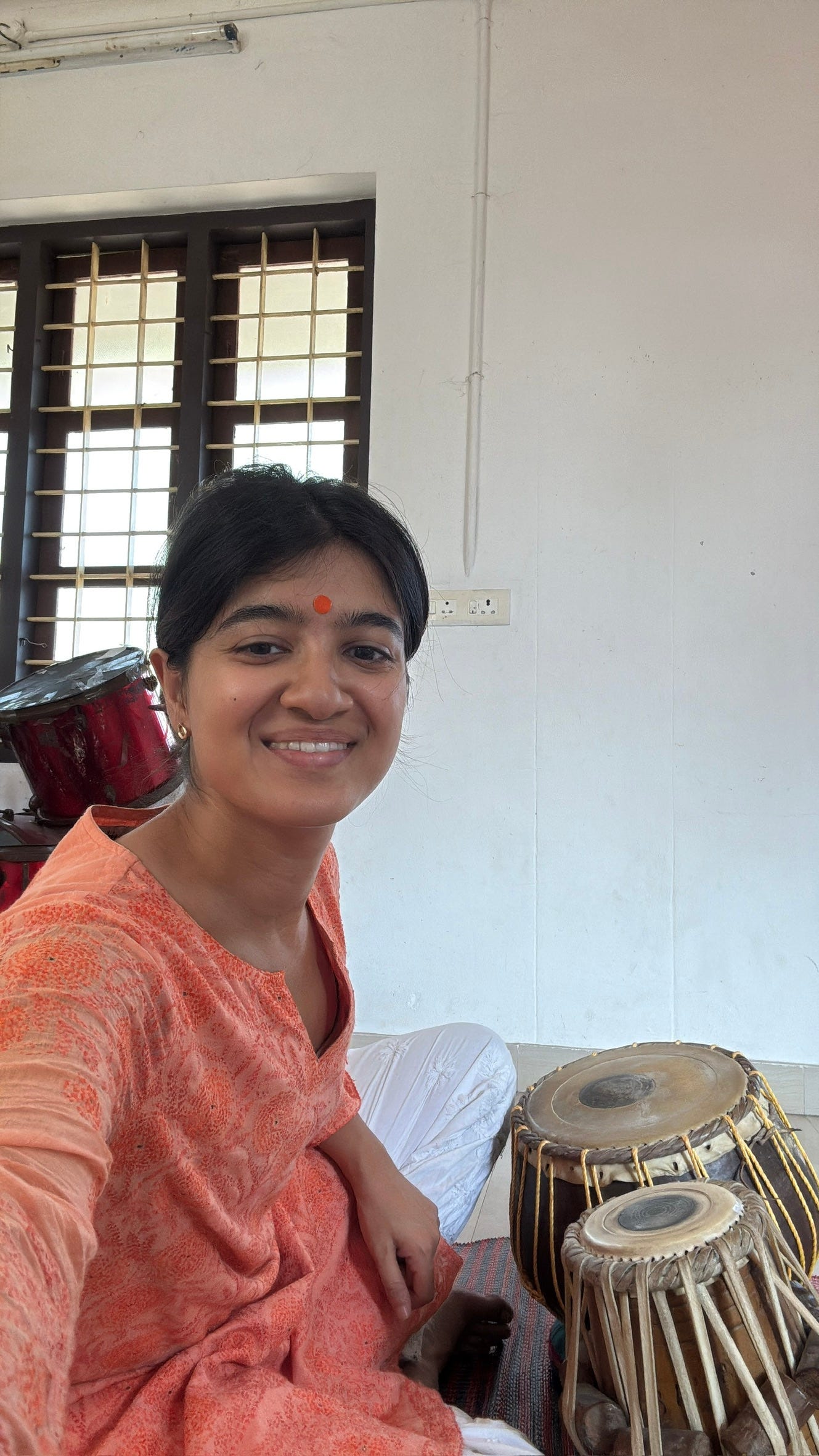
Kerala kept pulling me into its rhythms. I learned tabla (hand drum) patterns and their reverse patterns. I cracked open jackfruit (called chakka) with coconut oil on my fingertips to ease the stickiness, ground coconut by hand, found cinnamon tree saplings hiding in the garden and moved them somewhere they could properly grow. Just a TINY metaphor!! You can tell that the saplings are cinnamon by the smell and taste of the leaves alone. I pulled roots that felt like mandrakes to make the garden anew.
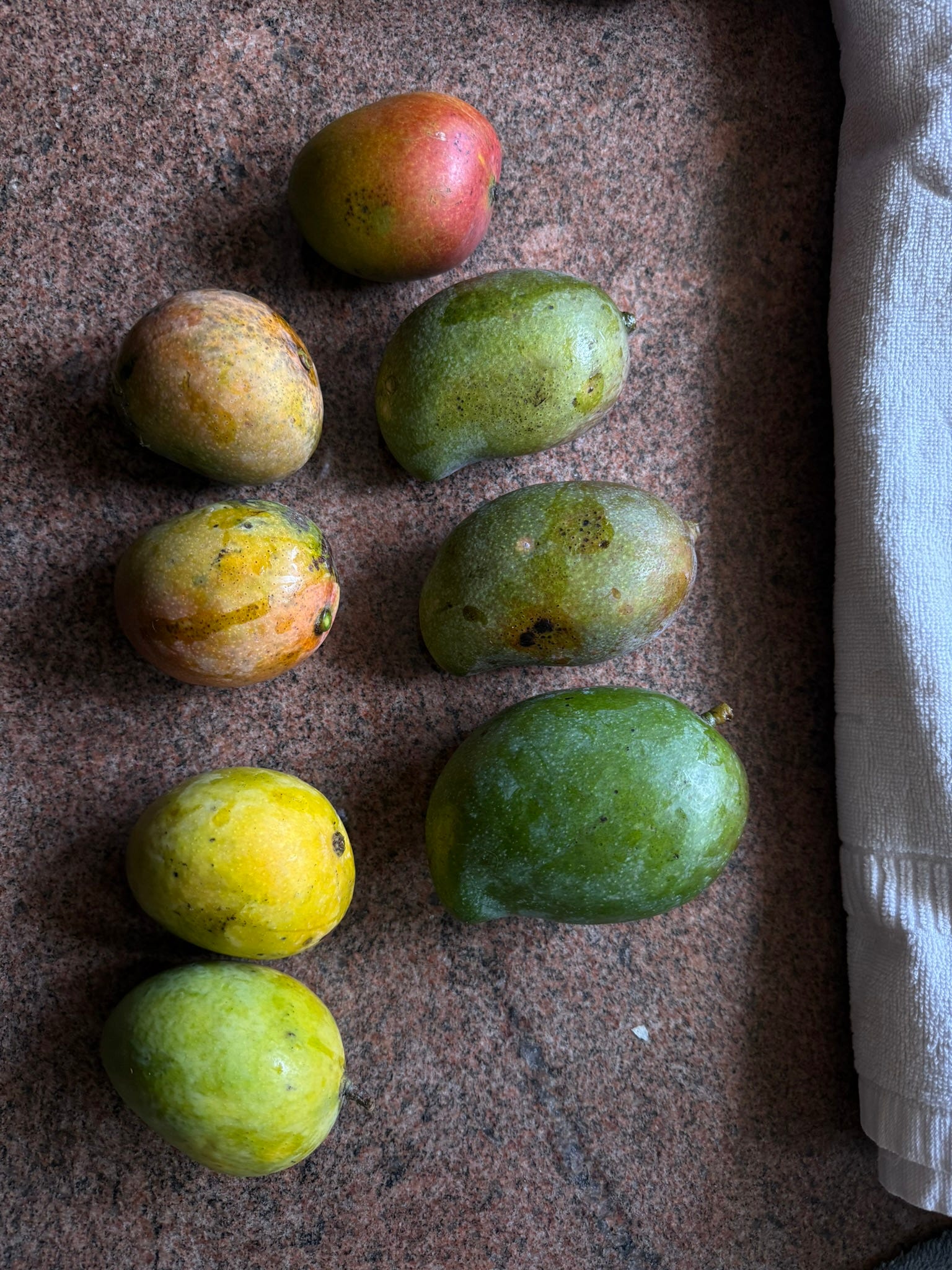
I made upmav from scratch — a Keralite spiced breakfast similar to grits — and watched the rava (flour) absorb water at an astonishing rate, the whole pot transforming in seconds. Summer (sometimes February to May) is mango season in Kerala, so my mom and I enjoyed almost-ripe mangoes, willing out every ounce of juice. She said it transported her to her childhood. Many variations of mangoes exist in this rainforest — the killichundan, named for their bird-beak tips, are the ones she grew up on. They carry a slight nutmeg aftertaste. We ate them like children. And for a moment, I became the child she was. Free to exist and trust that the land would provide for her because it always did.
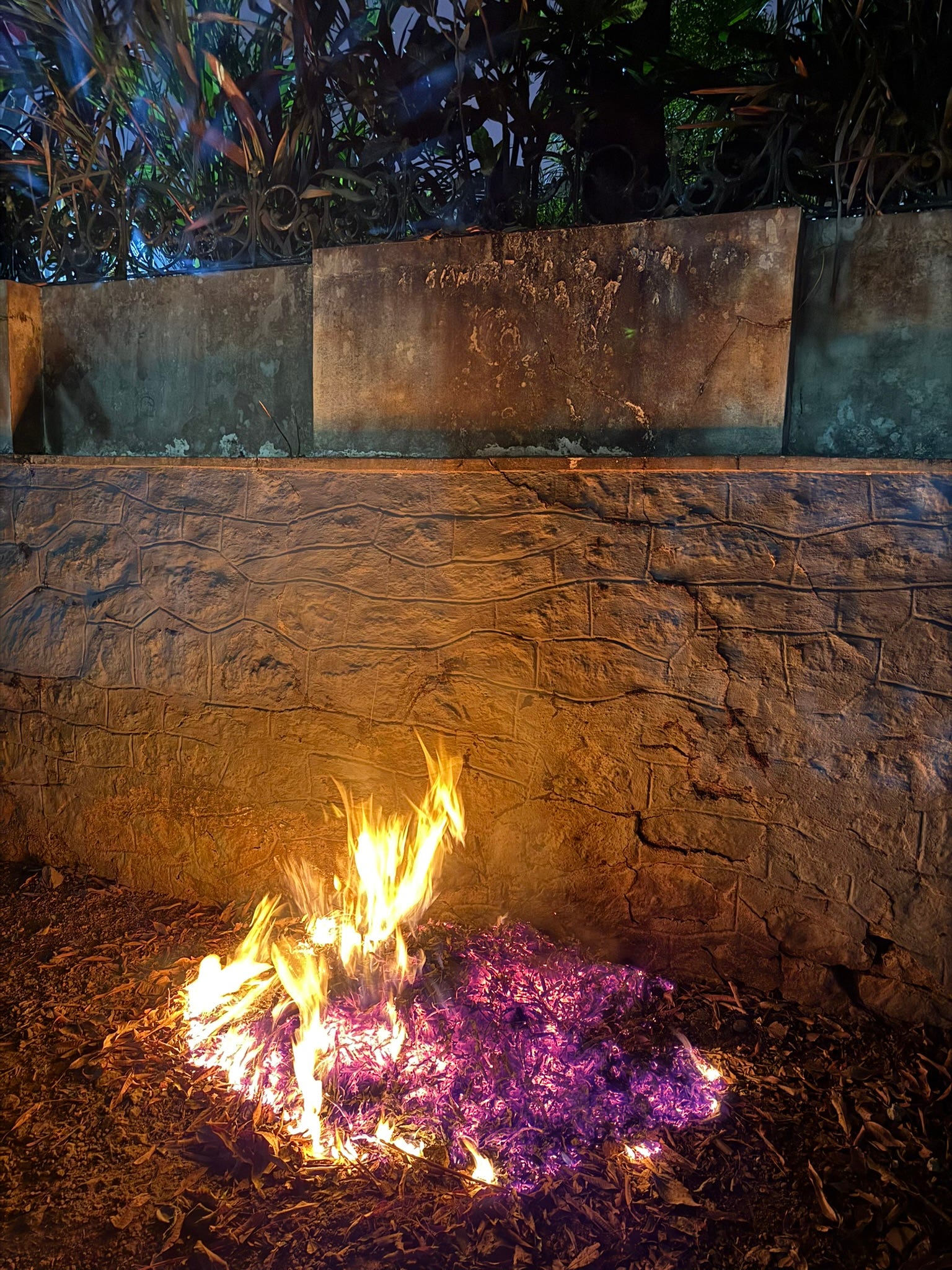
One evening of many, we started a fire in the backyard. And then another outside the front gate, clearing the brush and purifying the space. That evening, I fanned the flames with a little wind. Sparks rose, they intensified, and the flames were doused. And then — as if on cue — the lightning began.
A storm so needed broke open and poured through the floodgates.
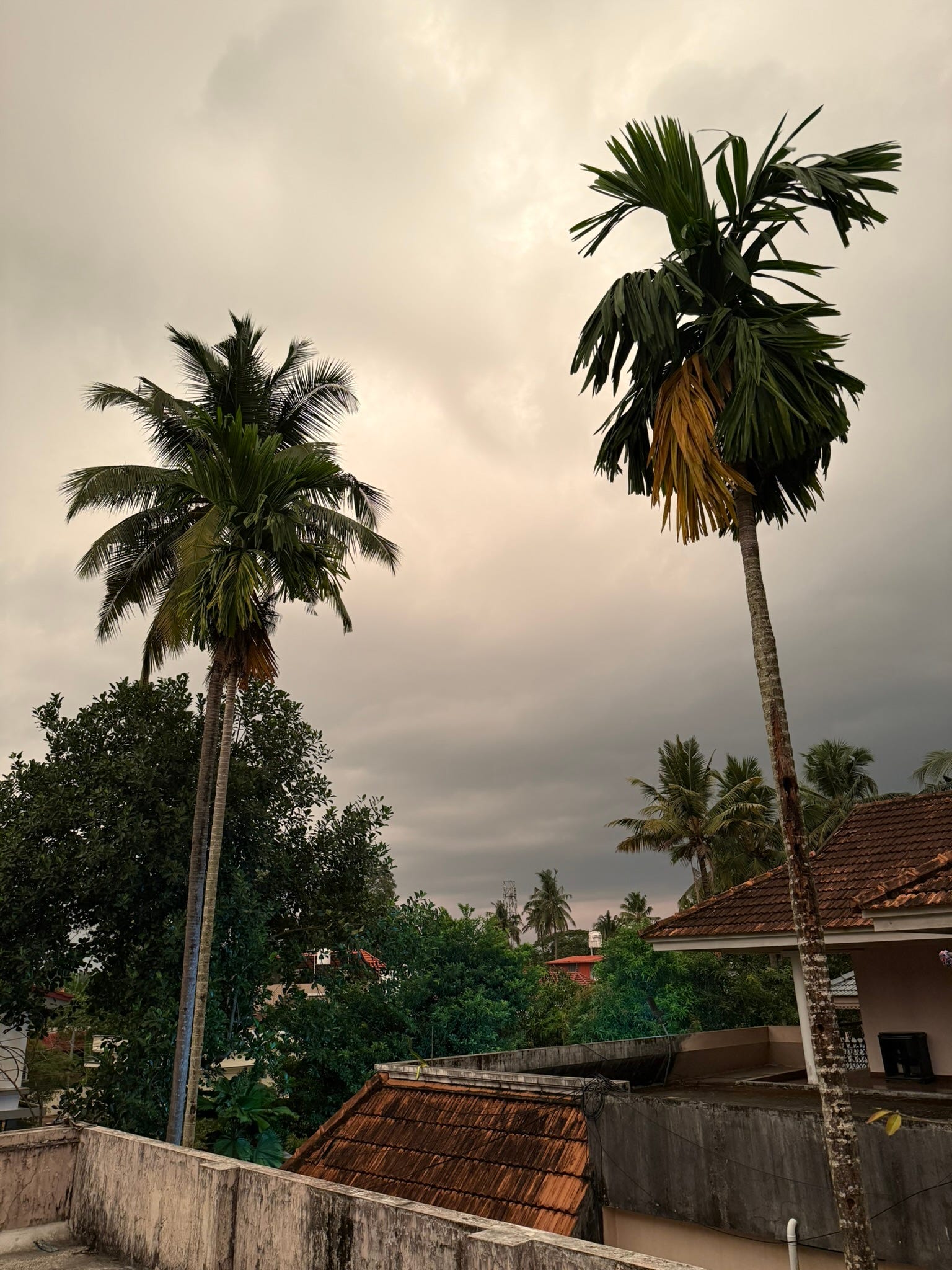
I sat on the porch for over an hour. Just listening. Touching the rain. Breathing it in. A Bible convention was going on nearby — you could hear voices carrying over speakers even through the downpour. People had chosen to sit inside and listen to humans interpret and explain.
And truthfully, I found it more holy to simply listen to the rain. Nature, once again, holds more answers than I have experienced any human having.
The lightning and thunder continued. The rain slowed to a drizzle. I sat there meditating. I didn’t feel the need to track the time.
These early weeks in Kerala challenged me. In ways I had experienced the last time I was here and in completely new ways. The early weeks turned into nearly two months during a war making its way around the world. Two months of no WiFi, for the most part. Two months without my car. No conveniences whatsoever. I fell in fissures. I found humans navigating impossible contradictions. I found quiet faith being strangled by noise. It was election season in Kerala, so you can only imagine!
And what Kerala showed me — in the breeze before the heat, in the laborer who showed up anyway, in the resilient dog — is that living well is not something you do once the corruption clears or the systems improve or the people around you become worthy of it.
Living well is the most radical act available to any of us, in any country, at any time. And making sweetness — out of whatever you have been given, cracked shells and all — is never naive. It is the bravest possible response.
Goodness needs no permission to grow.
With much love & to going beyond the surface,
Anjali
Next week: In-her-it Lives. — Kerala, India pt. 2.
Girl!
Some good writing ✍️ here!
Reminding me of Mathew Kelly’s writing
Brought a few tears and smiles to my face as I read this. Having been in those same spaces and how my brain took in information versus how you took it in shows me how varied our wirings are, hence, our perspectives! Mindfully honoring all of God’s varied creations in all forms and this read reiterates the reason to! Well done and thank you for compiling it meaningfully and sharing it 🌼🪔🤩